

Activity: Rethinking Fast Fashion
Overview
Fast fashion, the rapid production of inexpensive clothing designed to keep up with constantly changing trends, makes clothing more affordable and accessible, but it also creates significant social and environmental challenges. These include generating high levels of waste and pollution from textile production, extensive use of water, and labor issues in global supply chains. The fashion industry is also responsible for roughly double the carbon emissions of air and sea-based shipping combined.

https://environment.upenn.edu/sites/default/files/styles/large/public/2024-02/Screenshot%202024-02-16%20164855.png?itok=D7zkX_tz
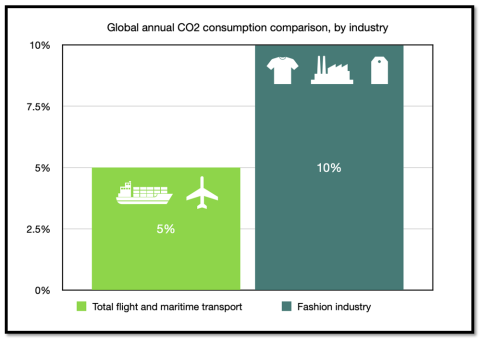
Before beginning the activity, each member of your group should (quickly) review one of the following resources.
- https://earth.org/fast-fashions-detrimental-effect-on-the-environment/
- https://davidsuzuki.org/living-green/the-environmental-cost-of-fast-fashion/
- https://environment.upenn.edu/news-events/news/fast-fashion
- https://www.gao.gov/blog/fast-fashion-great-your-wallet-costly-planet
- https://sustain.ucla.edu/2024/02/16/the-fast-fashion-epidemic/
- https://www.biologicaldiversity.org/programs/population_and_sustainability/sustainability/fast_fashion
- https://www.europarl.europa.eu/topics/en/article/20201208STO93327/fast-fashion-eu-laws-for-sustainable-textile-consumption
Step 1: Personal Connection & Observation
Take a moment to consider the following questions and then discuss briefly with your group:
- How does fast fashion show up in your life or the lives of people you know?
- What influences clothing choices? (What do we buy or wear, when, and why?)
- How often are clothes worn before being replaced or discarded?
- How long are clothes kept?
- How does culture impact our clothing choices?
- What happens to clothing after it is no longer wanted?
Step 2: Systems Thinking Across Scales
Think about how fast fashion operates at different levels.
- Individual: personal habits, purchasing decisions
- Family/Household: shared norms, budgeting, laundry and disposal
- School/Community: trends, peer influence, local swap, resale or donation options
- City/State: waste systems, local policies, economic activity
- National/Global: supply chains, labor systems, environmental impact
Discussion Questions:
- What social and environmental impacts are most significant?
- Which of these impacts are most connected to your own clothing use?

Step 3: Identifying Opportunities for Change
Consider where change might be possible:
- What can you control directly?
- What can you influence (friends, school, community)?
- Are there opportunities to act at a larger scale (campaigns, partnerships, awareness)?
Brainstorm possibilities such as:
- Changing purchasing habits
- Extending product life (repair, reuse, swapping)
- Educating others
- Working with organizations or starting initiatives
Step 4: Focus and Exploration
As a group, choose 1–2 ideas to explore further:
- What specifically would you try to change?
- What do you need to learn before acting?
- How could you test your idea on a small scale?
A few possibilities to consider:
- Conduct interviews or surveys
- Observe behaviors (at school, stores, online)
- Test a small intervention (clothing swap, awareness campaign)
- Map out how the system currently works
Step 5: Share and Next Steps
If we have time, each group will briefly present:
- Key insights from your discussion
- The change you are most interested in exploring
- One or two actions you could take next to begin

Activity 2: Morph and Circular Economy Challenges
Morph: Navigating the Challenges of a Values-Based, Upcycling Business
Morph is a brand built on a simple idea: waste can be a resource. By recovering post-industrial materials that would otherwise go to landfill, Morph designs and produces durable, functional products. Some items are manufactured for consistency and scale, while others are made through partnerships with informal seamstresses and refugees who are paid fairly, creating both environmental and social value. The goal is not just to make products, but to help build a circular economy where materials are kept in use and value is shared more equitably.
In going to market, a complex reality emerged. Unlike traditional businesses that rely on stable, predictable inputs, Morph depends on materials that are inherently uncertain. An organization that provides a resource that works well today might change its processes tomorrow and no longer generate the same waste. A supplier might go out of business entirely. Even relationships can shift—if a key contact leaves an organization, access to materials may be disrupted, requiring time and effort to rebuild trust. With each change
These uncertainties create ripple effects across the business. After investing time in testing and developing products from a specific material, Morph must maintain access to that source—but this is closely tied to sales. If products take time to sell, delays between material pickups can weaken supplier relationships. At the same time, retail partners often expect a conventional model: place an order and receive products within days. Morph cannot always meet those expectations, especially when materials, production timelines, and partner coordination are variable. This can make it more difficult to secure and sustain wholesale relationships, even when there is strong interest in the mission and products.
These tensions highlight a central challenge: building a business that stays true to its values—waste reduction, fair partnerships, and quality—while operating within systems designed for speed, consistency, and predictability. Progress depends not just on good design, but on coordination, trust, timing, and the ability to adapt to constant change.
All of this uncertainty is present while trying to develop a brand and grow sales enough to sustain the business and open the door to new opportunities.
Potential Challenges (a partial list)
- Material supply inconsistency
Waste streams are not steady. Materials may arrive in unpredictable quantities, vary over time, or become unavailable. - Variability in material properties affecting standardization
Even within the same source, materials can differ in thickness, durability, or appearance, requiring ongoing adjustments. - Limited control over future supply streams
Suppliers may change materials, alter processes, go out of business, or shift priorities, cutting off access unexpectedly. - Relationship dependency and continuity risk
Access to materials often depends on specific individuals; when contacts leave, partnerships may need to be rebuilt from scratch. - Ensuring product durability and quality
Products must meet consistent performance standards despite variability in inputs. - Design constraints due to irregular inputs
Products must be flexible enough to accommodate changing material sizes, shapes, and conditions. - Labor-intensive sorting, cleaning, and preparation
Recovered materials often require significant preprocessing before they are usable. - Difficulty scaling production with unpredictable inputs
Growth depends on both demand and material availability, which are rarely aligned. - Maintaining fair and ethical partnerships during growth
Scaling while ensuring fair compensation and stable work for partners requires careful planning. - Customer perception and education challenges
Customers and retailers may expect uniformity, speed, and consistency that are difficult to guarantee. - Logistics and coordination across partners
Managing timelines and expectations across suppliers, manufacturers, and makers adds complexity. - Retail expectation mismatch
Retailers often expect fast fulfillment (order today, ship in days), which conflicts with the realities of variable sourcing and production. - Risk of reputational harm, especially with partners
Delays, material changes, or inconsistent availability can strain relationships with suppliers and retail partners who depend on reliability.

Discussion Questions
There are two sets of questions below. The first looks at finding and sustaining our community in these circumstances and the second considers the challenge of running the business effectively amid uncertainty.
1. Finding and Sustaining Our Community
- Who should Morph’s target customers be? What values, behaviors, or interests would make someone a strong fit for this model?
- What types of products might resonate most with this audience (everyday essentials, unique statement pieces, limited editions)? Why?
- What kinds of waste materials or origin stories might customers find most compelling or meaningful?
- How can Morph effectively communicate what it does and why it matters—especially to people unfamiliar with circular economy concepts?
- What would help customers understand and accept variability in materials, colors, or availability?
- How could Morph build stronger engagement with its community (storytelling, transparency, events, collaborations)?
- Would it be valuable to share some of Morph’s challenges with customers? If so:
- Which challenges would be appropriate to share?
- How might sharing them build trust or interest rather than concern?
- Where and how should this communication happen (product tags, website, social media, in-person events)?
2. How to Run the Business Amid Uncertainty
- Which sourcing uncertainties present the greatest risk to the business, and why?
- Are there ways to reduce or manage these risks (diversifying material sources, building inventory buffers, standardizing parts of production)?
- How could Morph plan production when both material supply and demand are unpredictable?
- What systems or processes could make operations more resilient to disruption?
- How might Morph better align timelines and expectations with retail partners given these constraints?
- Are there business models (limited runs, pre-orders, made-to-order) that could better fit the realities of upcycling?
- Can any of these challenges be reframed as strengths? For example:
- Could variability become a selling point (uniqueness, limited runs)?
- Could scarcity increase perceived value?
- Could transparency about uncertainty differentiate the brand?
- What trade-offs might be required to grow while staying true to Morph’s values? (The potential for investors to get involved and related conflicts of interest are one possibility.)
- Where could partnerships (suppliers, organizations, customers) help stabilize or strengthen the system?
- If you were running Morph, what is one change you would test first to improve how the business handles uncertainty?
